Bullet Echo: PVP Shooter
- 4.6
- Rating
- 10.00M
- Installs
- Free
- Price
 Analysis by App-foxy
I went into Bullet Echo: PVP Shooter expecting a quick mobile shooter, but its strongest idea is not simply aiming faster than the other team. The game makes information feel limited, so every movement matters. You are trying to understand where danger is, decide whether to push or hold, and help your side survive long enough to take the objective. That gives each short match a tense, tactical rhythm that feels different from a typical run-and-gun game.
Developed by ZeptoLab, this free action game combines team-based multiplayer with battle royale-style pressure and a top-down, two-dimensional view. It is available for Android devices running at least version 6.0, and the current version is 7.8.2. The Teen content rating is worth remembering because the combat is the central activity, even though the presentation is stylized rather than realistic.
The game has clearly found a large audience, with an average rating of 4.5 from around 809 thousand ratings and more than 10 million installs. Those figures do not automatically make it right for everyone, but they match my impression that the basic loop is easy to start and difficult to master. I would recommend it to someone who wants mobile matches with more decision-making than a simple arcade shooter, provided that person is comfortable with online competition and optional purchases.
You May Also Like

 Blood Strike: 2.5 Anniversary
Blood Strike’s Loadouts Turn Every Drop Into a Tactical Gamble
A close look at Blood Strike’s custom loadouts: how fast access to signature weapons reshapes its battle royale rhythm, rewards preparation, and narrows the gap between fights.

 Pandora - Music & Podcasts
Pandora’s Music Is Easy to Start, but Harder to Recover
Pandora’s strength is its low-effort path from a seed to a station. Its weak spot is how much confidence it asks you to place in connection, setup, and quiet recovery.

 8 Ball Pool
 Is Built on Rivalries, Rematches, and Routine
A close look at the rivalries, rematches, shared routines, and unanswered safety questions that turn a quick pool match into a persistent mobile community.

 Samsung Music
’s Quiet Strength Is Playing What You Already Own
Its reach comes less from spectacle than from dependable access to a personal library. That simplicity is both the app’s strongest retention engine and its ceiling.

 AccuWeather: Weather Radar
AccuWeather Review: A Quick, Clear Forecast for Everyday Decisions
For everyday plans, the best forecast is the one you can understand quickly. AccuWeather makes rain timing, radar, and local conditions easy to act on, with a few trade-offs.

 Hill Climb Racing
Why Hill Climb Racing Still Turns Crashes Into One More Run
A tiny car, a bumpy hill and one more upgrade: Hill Climb Racing keeps resurfacing because its simple chaos makes every near-miss feel personal.
More From Our News Desk



What to expect when a match begins
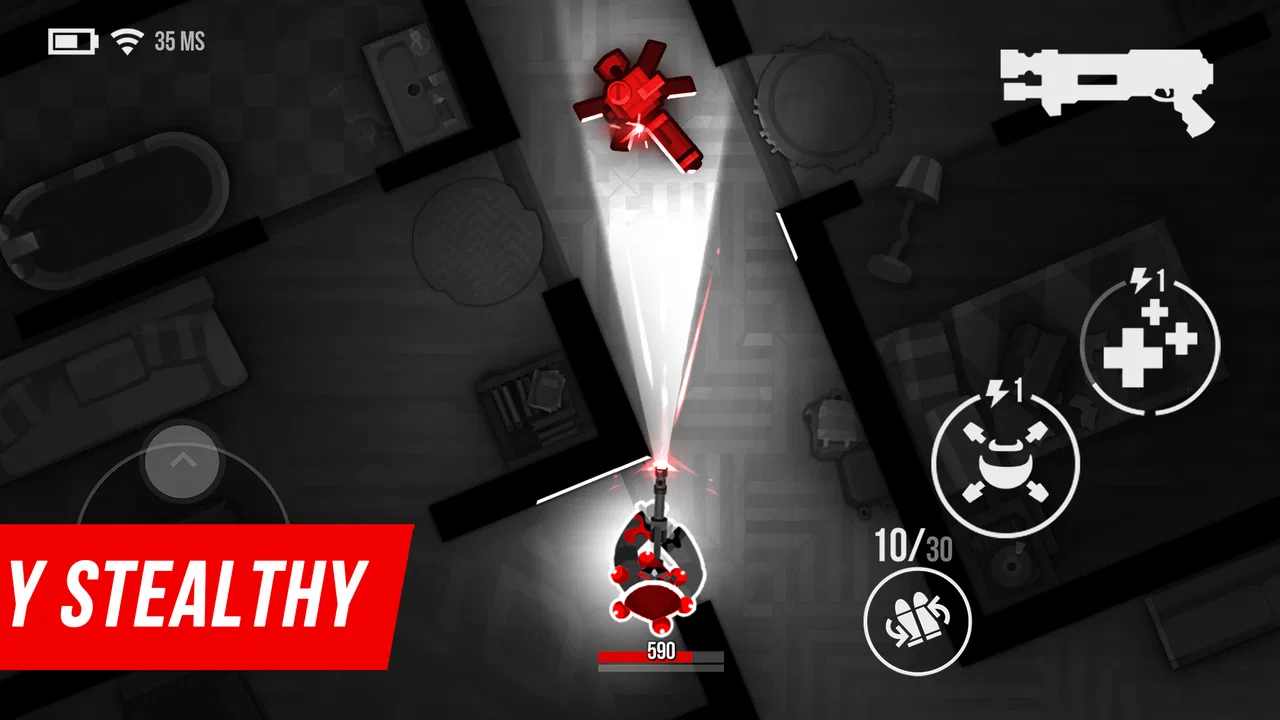
The first thing to understand is that this is not a conventional shooter where the whole arena is always visible and success comes from constant movement. Your character’s awareness is restricted, so the screen becomes a small window into a dangerous space. Sound, visible movement, the direction of teammates, and the timing of an attack all become useful clues. You are not only asking, “Can I hit that opponent?” You are also asking, “Is there another enemy nearby, and will firing reveal my position?”
That limited view gives the game its personality. A careless player can rush into a room and lose before understanding what happened. A patient player can wait near cover, listen for activity, and let an opponent expose themselves. I found that the most satisfying victories were often created before the shooting started, through positioning and restraint.
The action is still accessible. Controls are designed for a phone screen, and the basic goal of moving, targeting, and firing becomes familiar quickly. However, the simplicity of the controls should not be mistaken for a shallow game. Different characters encourage different approaches, and your team’s composition affects how aggressively you can play. A group with strong close-range pressure behaves differently from one that depends on careful distance and support.
Matches are a good fit for short breaks because the game gets to the action quickly. That does not mean every session feels casual. A single mistake can end your contribution early, especially when you separate from your teammates or attack without knowing what is around the corner. If you prefer games where losing has little consequence, the tension may feel tiring rather than exciting.
The battle royale influence is most noticeable in the way danger and uncertainty build during a match. You cannot safely treat the map as an open playground. Routes become more important, and being caught in the wrong area can turn a winning position into a desperate escape. I like this pressure because it stops matches from becoming static, but players who want predictable rounds may prefer a more traditional team shooter.
The first setup: keep the opening simple
Because the game is free, the easiest way to begin is to install it and focus on learning the movement and sight system before thinking about purchases. The store price is free, while optional in-app items range from $0.29 to $299.99 per item. That wide range is a reason to avoid treating the shop as part of the tutorial. I would first learn whether the core matches suit me, then decide whether any optional spending is worth considering.
On a first launch, I recommend resisting the urge to change everything immediately. Play with the default control arrangement long enough to identify what feels uncomfortable. Mobile shooters often become harder when a new player keeps adjusting buttons after every match. First learn whether the problem is the layout or simply the unfamiliar timing of movement, aiming, and firing.
Use the early matches to answer three practical questions. Can you move without looking down at the controls? Can you stop before entering an exposed area? Can you keep track of your teammates while watching for threats? Those abilities matter more at the start than trying to make a perfect build or chasing a high number of eliminations.
A useful habit is to treat your first few games as observation exercises. Notice how quickly your character turns, how much space is needed to retreat, and how long it takes to react after spotting an opponent. The game’s top-down perspective can make distances look simple, but small positioning errors are costly. If you learn those distances early, later decisions become much less frantic.
I also suggest choosing one character and learning that character’s practical role before constantly switching. Variety is one of the attractions of the roster, but changing styles every match can hide the reason you are losing. When you stay with one option for a while, you can tell whether a failed attack came from poor timing, bad positioning, or a mismatch between your chosen role and the situation.
How to reach a first meaningful success
For a new player, a meaningful first success is not necessarily being the top eliminator. It can be surviving a full engagement, helping a teammate finish an opponent, or retreating from a bad position without giving away the entire team’s location. Those smaller wins teach the habits that eventually produce more visible victories.
My preferred opening is cautious but active. I move with the team rather than racing ahead, use cover wherever possible, and avoid firing at the first hint of movement. Shooting can solve a problem, but it can also announce where I am. Waiting for a clearer target or a teammate’s pressure often creates a better opportunity than taking an uncertain shot.
When an opponent appears, I try to make one decision quickly: commit or disengage. Half-committing is usually the worst option. Advancing without support can leave me trapped, while retreating too late can expose the teammate behind me. If the enemy has the better position, breaking contact is not cowardice; it is a way to preserve the team’s options.
One non-obvious lesson is that surviving with low health or a damaged position can still be valuable if you draw attention away from a teammate who has a better angle. The game rewards awareness of the whole fight, not only personal damage. I have found that players who stay close enough to support but far enough not to be eliminated together are much more reliable than players who simply follow each other in a tight cluster.
Another useful technique is to pause after every major exchange. Do not immediately chase an opponent who retreats. Ask whether the retreat is genuine or whether it is pulling you toward another enemy. In a game built around restricted awareness, a sudden opening may be bait. A few seconds of patience can prevent a winning fight from becoming an unnecessary defeat.
If you are playing with unfamiliar teammates, use their movement as information. A teammate who suddenly stops, turns, or backs away may have noticed danger before you did. This does not mean following every action blindly, but it does mean avoiding the assumption that your own screen shows the complete situation. Team awareness is one of the easiest advantages to develop without spending anything.
Common confusion that can make the game feel unfair
New players may initially think an opponent has an unfair advantage because they were eliminated before seeing the attacker clearly. In many cases, that is the intended result of the visibility system. The important question is not only who had the stronger weapon or faster reaction. It is who created the better information advantage by approaching from cover, choosing the right angle, or waiting for a sound cue.
This can feel frustrating until you stop treating every unseen attack as random. Review the sequence mentally: Were you alone? Did you cross an open area? Did you fire at a target without checking an escape route? Did your team move in different directions? These questions turn a confusing defeat into something actionable.
Another common mistake is assuming that staying still is always safe. Holding a position can be smart, but a stationary player may become predictable. I prefer controlled movement: pause long enough to gather information, then relocate before an opponent can confidently surround that position. The best defensive play is often a position that can be abandoned quickly.
Players also sometimes confuse a character’s role with a guarantee of success. A close-range specialist still needs a safe approach, and a support-oriented character cannot repair a team that constantly splits apart. Character choice changes the tools available, but it does not remove the need for timing. If a style is not working, change the situation you create rather than blaming the character immediately.
The progression and shop elements can create another kind of confusion. Since optional purchases are available, a new player may wonder whether spending is necessary to enjoy the game. My advice is to treat spending as a personal convenience, not as the condition for learning. Play enough to understand the match flow first. If the competitive pressure itself is not enjoyable, purchases will not fix that underlying issue.
The Teen rating also gives a useful expectation about the tone. This is a combat-focused multiplayer game, not a quiet puzzle or a family-oriented board game. Parents should consider whether online shooting and competitive pressure fit the intended player. For adults and older teens who already enjoy action games, the stylized presentation makes it approachable, but the competitive tension remains real.
How it compares with familiar mobile shooters
Compared with a large, conventional battle royale, this game feels more focused. You are not spending most of a session traveling across a huge landscape, collecting a long list of equipment, or waiting for a final circle. The compact structure makes it easier to play during a short break, while the limited awareness creates tension without requiring a massive map.
Compared with a straightforward twin-stick shooter, it asks more of your judgment. In a pure arcade design, constant motion and fast aiming may be enough. Here, charging forward can be exactly what loses the match. The ability to hide information, protect a route, and coordinate pressure gives the game a stronger tactical identity than many quick mobile shooters.
It is also different from a solo action game because your performance is tied to other players. You can make a smart individual decision and still lose if the team collapses elsewhere. That can be rewarding when teammates cooperate, but it can also be the main source of irritation. If you want complete control over the outcome, an offline-focused alternative will probably feel more relaxing.
On the other hand, someone looking for a deep military simulation may find the simplified controls and stylized presentation too light. This is not trying to reproduce every detail of a realistic firearm or battlefield. Its appeal comes from readable character roles, fast encounters, and information management. I would choose it over a slower, more elaborate shooter when I want tactical decisions without a long commitment.
The next step after the beginner phase
Once the basic controls feel natural, stop measuring progress only by eliminations. Track whether you are arriving at fights with an escape route, whether you are protecting teammates from being surrounded, and whether you are choosing battles based on information rather than impatience. These are the habits that separate a player who occasionally gets lucky from one who consistently contributes.
Start learning the spaces around objectives rather than memorizing a single favorite hiding place. A strong location is useful only if you understand its approaches, nearby cover, and likely retreat paths. Rotate between defensive and aggressive positions so that you do not become predictable. This is one of the clearest ways to improve without needing a new character or an expensive item.
It is also worth experimenting with team spacing. Stay close enough to respond when a teammate is attacked, but avoid standing so near that one ambush catches everyone. In practice, this means moving as a loose group and checking whether you can reach the next player quickly. That small adjustment often improves survival more than rushing toward every visible target.
If you play daily, set a simple goal for each session. One session might focus on avoiding unnecessary early fights. Another might focus on supporting the teammate with the strongest position. A third might focus on learning when to retreat. This approach makes losses useful and prevents the game from becoming an exhausting search for constant wins.
There is a practical reason to keep expectations realistic: online matchmaking can produce uneven experiences, and no personal strategy can control every teammate or opponent. When a match feels chaotic, identify the part you could influence. Maybe you separated too far, revealed yourself too early, or chased a retreat. If none of those happened, accept the loss and move on rather than turning every result into a verdict on your ability.
I would skip this game if you dislike competitive multiplayer, become frustrated by indirect information, or want a shooter where every death feels immediately understandable. I would also look elsewhere if you need a fully offline experience or prefer long, cinematic campaigns. The game’s strengths depend on short online encounters, team interaction, and the tension of not seeing everything.
For the right player, though, the free entry point is appealing. You can test the central gameplay without committing to a purchase, and the core lesson is easy to understand: move carefully, share pressure with your team, and do not waste information. The optional item range means I would keep an eye on spending, particularly for younger players, but the decision to spend can come after you know whether the matches are genuinely fun.
After spending time with it, my recommendation is straightforward. Try it if you want a mobile tactical shooter that rewards patience as much as reflexes. Give yourself several matches to learn the visibility rules instead of judging the game after one confusing defeat. The first satisfying win usually arrives when you stop chasing action and begin creating a favorable encounter.
Bullet Echo: PVP Shooter works best as a compact competitive game with a distinctive sense of uncertainty. It is quick to enter, demanding to master, and honest enough to punish careless movement. I would not call it the best choice for every shooter fan, but for someone who wants team battles where positioning and awareness matter, it is an easy game to recommend trying.
FAQs for Bullet Echo: PVP Shooter
01What is the core gameplay of Bullet Echo?
Bullet Echo is a unique tactical team-based shooter that emphasizes stealth and strategy. Players must navigate dark maps where visibility is limited to the beam of their flashlight. Collaborate with teammates to use sound and light to locate enemies, plan ambushes, and secure victory. The game combines the intensity of battle royale with tactical decision-making.
02Does Bullet Echo support multiplayer gameplay?
Yes, Bullet Echo is designed for multiplayer experiences. Players join teams and work together to outsmart and outmaneuver opponents. The game supports both local and online multiplayer modes, allowing friends or players from around the world to team up or compete in intense, strategic matches.
03Is Bullet Echo free to play, and are there in-app purchases?
Bullet Echo is free to download and play, but it includes in-app purchases. These purchases allow players to buy cosmetic items, new characters, and other enhancements. While spending can enhance gameplay, it's not necessary to enjoy the core experience, as the game is designed to be balanced for all players.
04What are the system requirements for Bullet Echo on mobile devices?
Bullet Echo is available on both Android and iOS devices. For Android, it requires a minimum of Android 6.0 and up, while iOS devices need iOS 10.0 or later. The game runs smoothly on most modern smartphones and tablets, but having a device with updated software ensures the best performance.
05How does Bullet Echo ensure fair gameplay for all players?
Bullet Echo uses a skill-based matchmaking system to ensure fair competition. Players are matched with opponents of similar skill levels, creating balanced gameplay experiences. Regular updates and active moderation help prevent cheating and maintain a fair, enjoyable environment for all participants.
Pros
- Unique team-based strategy gameplay.
- Distinct hero abilities add depth.
- Visually appealing graphics and design.
- Quick matches ideal for short sessions.
- Frequent updates with new content.
Cons
- Limited map selection can feel repetitive.
- Requires constant internet connection.
- In-app purchases can be quite costly.
- Some heroes feel overpowered.
- Occasional matchmaking imbalances.

Bullet Echo: PVP Shooter
Gallery